
AI is changing interior design, and making the designer matter more, not less
Published 1 June 2026 · By Subhra
In short
AI has not replaced interior designers. It has changed the job. Tools like Midjourney, Google's Nano Banana and assistants such as Claude now let clients arrive with dozens of renders, layouts and references, which makes them far better informed and faster to align with. But more options is a harder problem, not an easier one. Most AI images cannot actually be built: they ignore budget, structure, scale and Dubai's climate, and rarely add up to one coherent home. The designer's value has moved from generating ideas to editing them, choosing the one direction that fits the client's life, the theme and the building, and turning it into something real.
AI didn't replace the designer. It replaced the blank page.
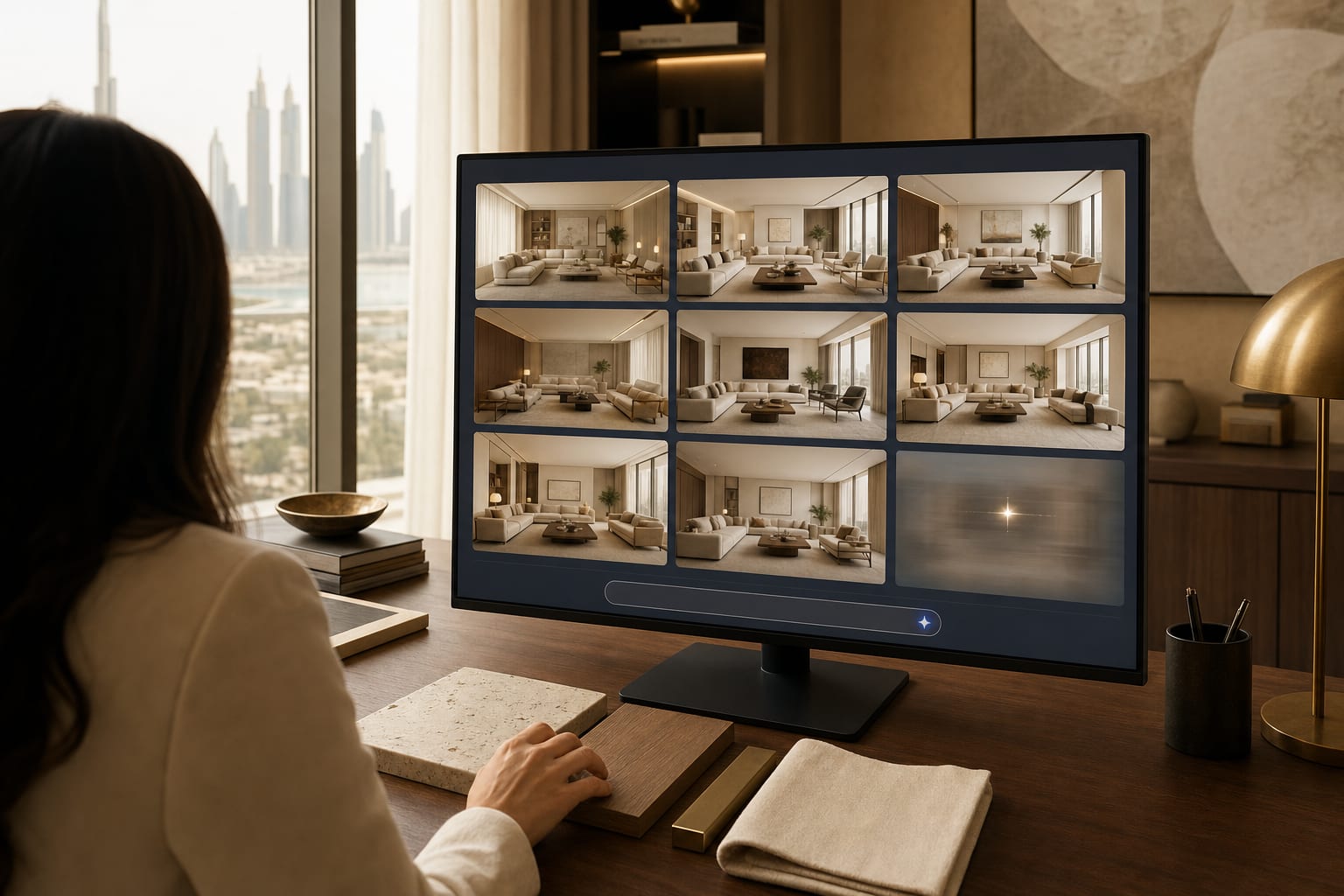
Clients used to arrive with a vague feeling and a few magazine tears. Now they arrive with forty Midjourney renders, a Nano Banana edit of their own living room, three Pinterest boards and an AI floor plan they generated over a weekend. The blank page, historically the hardest part of any brief, is gone. That is genuinely good news. It means the first conversation starts further along, with someone who already knows whether they lean warm or cool, open-plan or compartmented, minimal or layered. We don't see that as a threat. We see a client who has done the most useful homework possible before walking in the door.
An informed client is the best thing to happen to design
We don't fear the research; we want more of it. A client who has spent ten evenings inside tools like Midjourney, Nano Banana and Claude has, without quite realising it, built a visual vocabulary. They can tell us a render feels 'too cold' or 'too hotel', feedback that used to take three meetings to surface and now arrives on day one. Shared language compresses the entire project. The old myth that designers prefer a passive client is exactly backwards: the more clearly you can show us what moves you, even in imperfect AI images, the faster and the truer the result.
But more options is a harder problem, not an easier one
Here is the catch nobody markets. Generating a beautiful room is now free and effectively infinite: type a sentence, get twenty variations, refine, repeat. What AI cannot do is choose. A folder of two hundred gorgeous, unrelated images is not a design; it is a mood with no spine. Left unedited, abundance produces incoherence: a Japandi living room beside a maximalist majlis beside an industrial kitchen, each lovely on its own, together a collision. The scarce resource was never inspiration. It is judgement, knowing which one, and why, and what to leave out.
AI is fluent in images, illiterate in buildings
An AI render does not know that your slab can't carry that cantilever, that the marble river it drew across the floor will etch within a year of Dubai's hard water, that the walnut wall it placed against south-facing glass will fade over two Gulf summers, or that the open ceiling it loves needs an MEP coordination drawing the image will never show. It has no budget, no programme, no Dubai Municipality, no fourteen-week lead time on imported stone. It renders the photograph of a home, not the home. Translating a beautiful image into something buildable, compliant and durable in this climate is precisely the work that does not fit inside a prompt.
The designer's job moved up the stack: from drawing to editing
For decades, part of a designer's value was in generating the idea. That part is being commoditised, and that is fine. The value has moved up, to curation, editing and coherence. The job now is to sit with your two hundred images and find the three percent that share a through-line: the proportion you keep returning to, the palette underneath the noise, the one move that is unmistakably you. Then we build a single, disciplined scheme around it. Anyone, and any tool, can hand you options. Choosing well, against a theme, a budget and a life, is the entire game.
What this looks like on a Dubai project
A recent client arrived with around sixty AI images spread across four 'styles' she loved. Laid out on the table, the truth was clear within twenty minutes: beneath the surface variety, she was consistently drawn to low horizontal lines, bone-and-walnut warmth and one quiet thread of brass, not the chrome-and-gloss renders she thought she wanted. We kept the spirit of her three strongest images, set the other fifty-seven aside, reconciled the direction with her villa's structure, her budget and the climate, and delivered one coherent home instead of four competing ones. The AI got her to the table faster. The editing is what got her a house she still loves.
Taste is the scarce resource now
When generating options costs nothing, the value of judgement rises rather than falls. AI has made everyone a more capable briefer and a more confident collaborator, and it has made the designer's eye, the part that says 'this one, not those' and can defend why, more valuable than at any point in the last decade. So use every tool you like before you call us, whether that is Midjourney, Nano Banana or a custom Claude skill built around your brief. Arrive with your hundred images. Then let us do the one thing the tools can't: choose, edit, reconcile and build.
Quick answers.
No, but it is changing what they are paid for. The generative part of the work, producing options and inspiration, is increasingly commoditised. The judgement-led part, editing hundreds of references into one coherent, buildable scheme that suits your life, your budget and the Dubai climate, is becoming more valuable, not less. The designers at risk are the ones who only ever sold ideas; the ones who sell taste, coordination and execution are safer than ever.
You have done the most useful homework possible, and we would genuinely like to see it. What you have is a brief expressed in pictures. What is usually missing is the through-line (most AI folders contain three or four conflicting directions), the buildability (structure, MEP, budget, lead times and authority approvals) and the climate-proofing. Bringing a clear set of AI references to a designer typically shortens the concept phase rather than removing the need for one.
We treat them as direction, not instruction. Most renders cannot be built exactly as shown. They ignore scale, structure, lighting physics, budget and the realities of sourcing in Dubai. We extract what you actually respond to in an image (the palette, the proportion, the mood) and rebuild it as something that will exist, function and last, rather than copying a picture that was never designed to be real.
Selectively, as one tool among many. We use Midjourney and Nano Banana for fast early visualisation and Claude, including custom skills, to structure briefs and research. But concept direction, material choice, space planning, documentation and site execution remain human-led. AI is useful for showing options fast; it is not a substitute for the judgement that decides which option is actually right for your home.
- How to choose an interior designer in DubaiFive questions to ask before you sign.
- Why hire an interior designer in DubaiWhat a designer actually does on a Dubai project.
- Residential interior design in DubaiFounder-led design from concept to handover.
- Interior design trends in Dubai (2026)The warm, material-led direction worth editing toward.
Written by
Subhra
Founder & Principal Designer
Subhra is the founder and principal designer of ZuriSpace, leading every project from first conversation to final reveal across the UAE and India.
Read Subhra's profile →