
Apartment renovation in Dubai: costs, tower rules and what actually works
Published 18 June 2026 · Updated 18 June 2026 · By Subhra
In short
An apartment renovation in Dubai typically costs AED 100,000 to 900,000+ depending on scope. A styling and furniture-led refresh that keeps the layout runs from AED 100,000. A full fit-out with new joinery, kitchen, flooring and built-in wardrobes runs from AED 250,000 to AED 900,000, roughly AED 150 to 400 per square foot. Tower-management NOCs, contractor registration, goods-lift booking and noise windows shape the timeline as much as the design. Storage, layout and lighting drive both daily comfort and resale or rental value.
Why apartment renovation is its own discipline
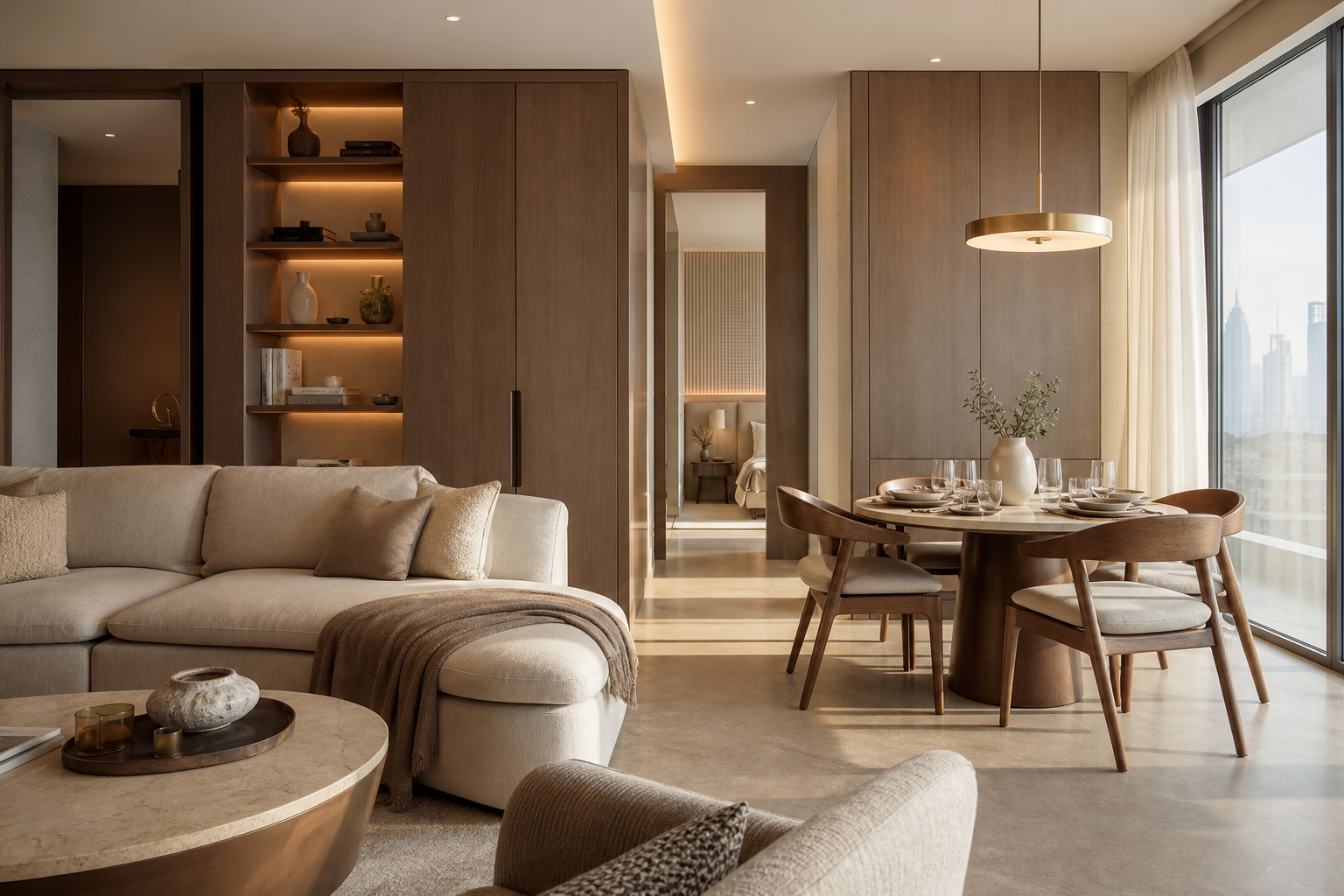
A villa renovation is about space and structure. An apartment renovation is about constraint: a fixed shell, a wet wall you usually cannot move, compact rooms, and a building that polices every hour of the build. Most Dubai apartments are bought as developer handovers, generic joinery, flat lighting, a showroom kitchen, and owners want them to feel like an architectural home rather than a leasing unit. The skill is not adding more; it is planning storage, light and flow so a one or two-bedroom unit lives far larger than its square footage. This is the same brief whether the apartment is in Dubai Marina, Downtown, JVC or Business Bay.
Three scopes: styling refresh, partial fit-out, full fit-out
A styling refresh keeps the layout and finishes and layers furniture, lighting, drapery, art and FF&E on top. Fastest and least disruptive: typically 6 to 10 weeks, from roughly AED 100,000. Ideal for a fresh handover or a rental-ready unit. A partial fit-out replaces joinery and wardrobes, reworks the kitchen or a bathroom, upgrades flooring and lighting, but leaves the layout largely intact. Runs 8 to 14 weeks, commonly AED 180,000 to AED 500,000. A full fit-out strips the apartment back, re-plans where the building allows, replaces every finish, and rebuilds kitchen, bathrooms, joinery, flooring and lighting as one scheme. Runs 10 to 18 weeks, typically AED 250,000 to AED 900,000+. The discipline is choosing the smallest scope that fixes how you actually live, not the largest the contractor can quote.
Tower rules are half the project
This is what makes Dubai apartment renovation different from anywhere else. Almost every tower requires a fit-out NOC from building management before a single wall is touched: approved drawings, contractor registration, a security deposit, fixed working-hour windows, and a goods-lift booking system that can become the real bottleneck on a 40th-floor unit. Some buildings ban wet-area relocation entirely, restrict gas, or limit core-drilling. We survey the fit-out manual first and design within it, then prepare the approval pack so submissions run in parallel with joinery lead times. Projects that slip almost always slip here, because someone started demolition before the NOC was issued. Developers like Emaar, Nakheel, Meraas and Damac each run their own approval track, which we coordinate as standard.
Planning compact, high-rise space
The single biggest lever in an apartment is storage that disappears into the architecture. Full-height wardrobes, a proper entry zone, concealed laundry, and joinery that follows awkward columns rather than fighting them. The second lever is the kitchen: in compact Marina or JLT units a peninsula often beats an island that blocks circulation, and open-plan only works where the building allows extraction routing. The third is making the view, where you have one, the loudest thing in the room, with a palette and lighting plan that frame it instead of competing. Mirrors, sightlines and a single continuous flooring run all make a small apartment read larger without moving a wall.
What drives the cost
Bespoke joinery is usually the largest line item, especially full-height wardrobes and a reworked kitchen. Flooring is next if you replace the developer tile with large-format porcelain or engineered timber across the unit. Then kitchen and bathroom finishes, then lighting if you re-circuit for layered, dimmable scenes. What moves the number less than people expect: paint colour, handle style and decorative accents, the things that photograph well but rarely change daily life. A designer-led renovation puts budget into the line items that change how the apartment functions and how it performs on the market. As a rough build guide, expect AED 150 to 400 per square foot once you pass a simple refresh.
Materials that survive towers and hard water
High-rise living in the Gulf punishes the wrong specification. Hard water etches polished stone in kitchens and bathrooms; high-gloss lacquer shows every fingerprint in strong window light; cheap engineered timber cups at AC drop-offs. We specify honed or sintered stone, fumed or matte-lacquer joinery, large-format porcelain or quality engineered timber, and brassware rated for local water. South and west-facing units near floor-to-ceiling glass also need UV-aware fabric and finish choices. See our guide on materials for Dubai's climate before you commit to a sample that will not survive.
Renovating remotely as an overseas owner
A large share of Dubai apartments are owned by investors and end-users living abroad, and the renovation has to run without them on site. We manage these projects through WhatsApp, weekly video walkthroughs and a shared folder holding CAD, material selections and progress photos, so an owner in London or Mumbai signs off the same decisions they would in person. Tower approvals, deliveries and snagging are handled on the ground. Our guide to working with a designer from abroad covers how the remote process is structured.
Timeline week by week
Weeks 1 to 2: site survey, fit-out manual review, scope decision and quotation. Weeks 3 to 5: layout locked, joinery and wardrobe shop drawings, kitchen and bathroom design, material and FF&E selection. Weeks 4 to 6: tower-management NOC submitted, contractor registered, goods-lift slots booked. Weeks 6 to 12: demolition where permitted, MEP, joinery installation, stone, flooring and lighting. Weeks 12 to 16: FF&E delivery, styling, and a snagging window. Add time for buildings with strict lift access or limited working hours. The critical path is almost always custom joinery lead times and approval turnaround, not the visible finishes.
Apartment renovation, resale and rental yield
Dubai is a market of comparison, and a renovated apartment that photographs well and feels move-in ready commands a premium over the identical shell next door. A coherent fit-out can lift rental income meaningfully on a well-located unit and remove the mental discount buyers apply to dated interiors. For investors, a furnished apartment designed as one scheme, rather than a furniture delivery, unlocks the furnished premium in towers across Marina, Downtown and Business Bay. The upgrades that pay back are storage, kitchen, bathrooms, flooring and lighting; see our guide on increasing property value through interior design for the full picture.
Where ZuriSpace fits
ZuriSpace designs apartment renovations as complete interiors, led personally by Subhra from first survey to final styling. We document in full, coordinate tower approvals, oversee the build through trusted contractors, and run the whole project remotely for owners abroad. Whether it is a styling refresh in a Downtown tower, a full fit-out in Creek Harbour, or a rental-ready upgrade in JVC, the principle is the same: plan the constraint properly, then make the apartment live larger than its floor plan. Pair with our kitchen and bathroom renovation guides when those rooms lead the brief.
Quick answers.
A styling and furniture-led refresh that keeps the layout typically runs from AED 100,000 to AED 400,000. A full fit-out with new joinery, kitchen, flooring and built-in wardrobes commonly runs from AED 250,000 to AED 900,000, roughly AED 150 to 400 per square foot. Penthouses and large waterfront units go higher.
A styling refresh runs 6 to 10 weeks. A partial fit-out runs 8 to 14 weeks. A full fit-out runs 10 to 18 weeks once tower approvals are in place. Goods-lift access, working-hour windows and joinery lead times usually set the critical path.
Almost always. Most towers require a fit-out NOC from building management, contractor registration, a security deposit and a goods-lift booking before work starts. Many buildings restrict moving wet areas, gas or structural elements. The approval pack should be prepared during design, not after demolition.
Sometimes, with approval. Many towers prohibit relocating wet areas because of the plumbing stack and waterproofing risk to units below. We check the fit-out manual first and only plan a wet-area move where the building and MEP allow it.
Routinely. Many of our apartment clients are overseas. We run the project via WhatsApp, weekly video walkthroughs and a shared folder with CAD, materials and progress photos, and handle approvals, deliveries and snagging on the ground.
Often, yes. A coherent, durable fit-out helps a unit photograph and lease at the top of its bracket, and a furnished scheme designed as one interior unlocks the furnished premium in high-demand towers. Storage, kitchen, bathrooms, flooring and lighting deliver the strongest returns.
- Apartment interior design in DubaiFull apartment fit-out and styling by ZuriSpace.
- City Walk handover: what to upgrade firstErin, Castleton, Thyme and Fern 3BHK handovers.
- Kitchen renovation in Dubai: full guideCosts, timelines and layout for the room owners change first.
- Working with a designer from abroadHow apartment fit-outs are run remotely for overseas owners.
- How to increase property value in DubaiWhich apartment upgrades lift resale and rental value.

Written by
Subhra
Founder & Principal Designer
Subhra is the founder and principal designer of ZuriSpace, leading every project from first conversation to final reveal across the UAE and India.
Read Subhra's profile →