
Hospitality interior design in Dubai: guest experience, back of house, and what it costs
Published 21 July 2026 · Updated 21 July 2026 · By Subhra
In short
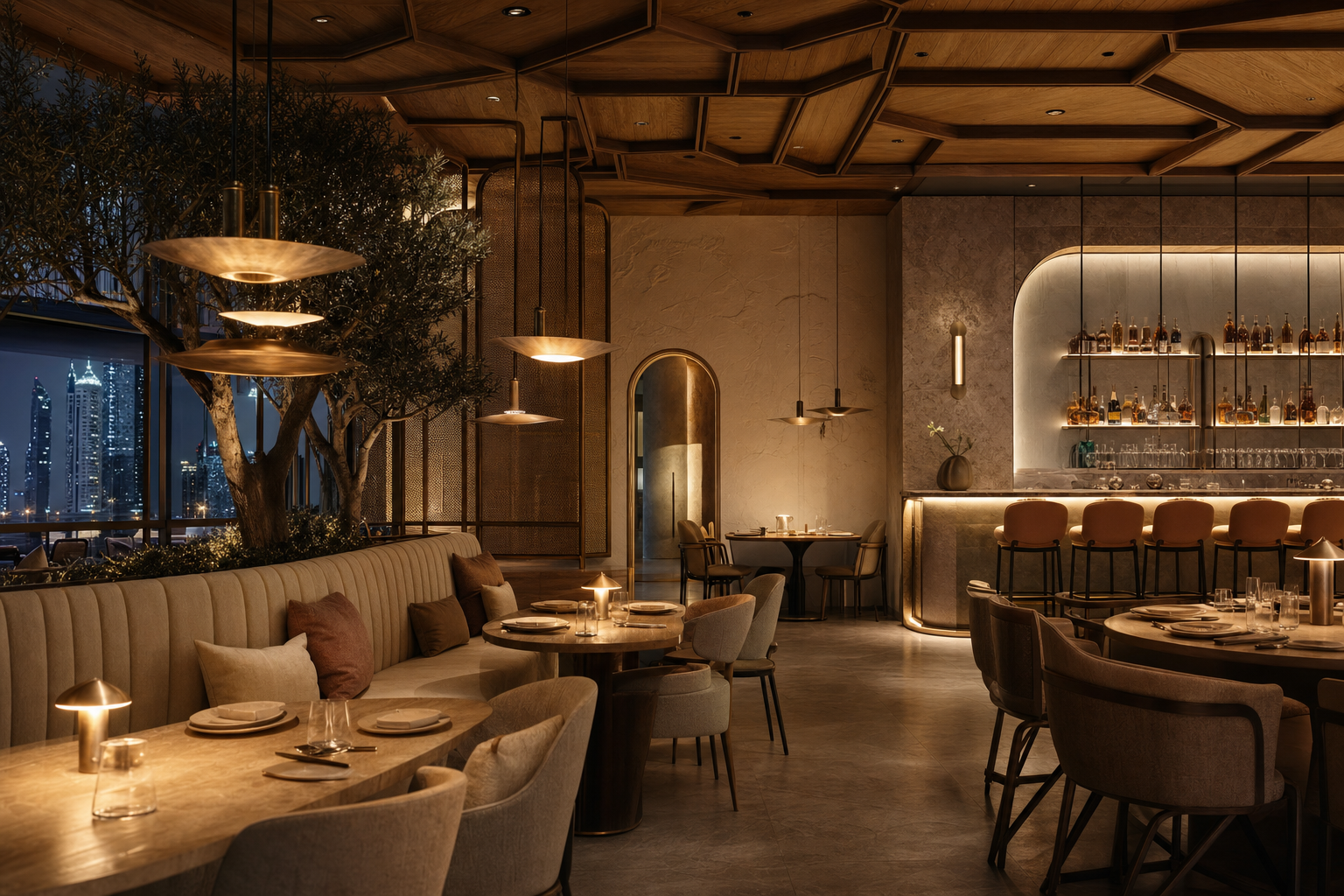
Hospitality interior design in Dubai covers restaurants, cafés, lounges, hotels and spas, spaces designed around a guest experience while a demanding back of house makes that experience possible. It is the most complex commercial discipline because kitchens, bars and wet areas bring extraction, waterproofing, food-safety approvals and the heaviest MEP. As designed-and-delivered projects, a café or lounge commonly starts from around AED 500,000, a restaurant from around AED 700,000 and runs 16 to 24 weeks, and hotel and spa work scales well beyond that. Approvals, Dubai Municipality food control, Dubai Civil Defence, the landlord or mall, and DTCM for hotels, set the schedule more than the design. ZuriSpace designs hospitality in-house and oversees the build on site through trusted contractors.
Hospitality sells an experience, then has to deliver it
A hospitality space makes a promise the moment a guest walks in, of a certain mood, service level and price, and then the whole operation has to keep it. That is what makes hospitality interior design different from any other commercial work: the design has to create atmosphere and stagecraft for the guest while quietly enabling a kitchen, bar and service team to perform at speed behind the scenes. Lighting, acoustics, seating comfort and the arrival sequence build the experience; the back of house, kitchen, stores, wash-up, staff routes, decides whether that experience survives a full Friday-night service. Get the front beautiful but the back wrong and the room looks the part while the operation falls apart. The two have to be designed as one.
Many formats, one spectrum of complexity
Hospitality in Dubai spans a wide range, and complexity climbs with the food and wet-area load. A café or coffee concept is the lightest, though it still needs a compliant back-of-house and extraction. A full-service restaurant adds a commercial kitchen, cold and dry stores, wash-up and often a bar, which brings the heaviest MEP of the group. A lounge or bar leans on atmosphere, acoustics and a wet bar. A hotel is a portfolio of spaces at once, lobby, rooms, restaurants, spa, back-of-house, tied to brand standards and the most demanding approvals. A spa or wellness venue adds intensive waterproofing, humidity control and treatment-room servicing. Knowing exactly where your concept sits on that spectrum is the first step to a budget and programme that hold.
The guest journey is the design brief
Great hospitality design choreographs a sequence: the approach and signage, the threshold and host stand, the reveal of the room, the walk to the table, the view from every seat, and the trips to the washrooms that no one should dread. Each moment is a design decision. Seating mix, banquettes, loose tables, bar stools, private corners, determines both the atmosphere and the covers you can turn. Sightlines decide whether a room feels generous or exposed. Acoustics decide whether guests can actually talk, the single most common failure in Dubai venues that photograph beautifully and sound like an airport. Even the washrooms carry the brand. Designing the journey deliberately is what turns a good-looking room into a place people book again and recommend.
Back of house is where projects are won or lost
Guests never see it, but the back of house governs whether a venue can operate. A commercial kitchen has to be laid out for flow, prep, cook, plate, wash, without cross-contamination, and sized to the menu and covers. Extraction and make-up air, grease management, cold rooms, dry stores, staff facilities and clear service routes to the floor all have to be resolved early, because they drive both cost and the food-control approval. Under-sizing the kitchen or squeezing stores to gain a few covers is a false economy that haunts a venue for its whole life. A designer who treats back of house as an afterthought is a warning sign; in hospitality it deserves as much rigour as the dining room, arguably more.
Approvals: food control, Civil Defence, landlord and DTCM
Approvals, not the design, set the hospitality timeline. Food and beverage venues need Dubai Municipality food-control approval covering kitchen layout, finishes, extraction and food-safe materials, alongside Dubai Civil Defence sign-off for fire and life safety, plus the landlord's or mall's own design and delivery process. Hotels and serviced hospitality bring the Department of Economy and Tourism (DTCM) classification and standards into the picture as well. Each authority has its own drawings, registered-contractor expectations and inspection stages, and they run in sequence and in parallel. A single rejected kitchen drawing can cost two weeks. The venues that open on time start the approval track on day one, alongside design, and work with people who have submitted in that district and format before.
What actually drives the cost
In hospitality the budget concentrates in a few heavy areas. The commercial kitchen and its extraction and MEP are usually the single largest cost, followed by the bar and any wet areas with their waterproofing and servicing. Bespoke joinery, banquettes, the bar itself, host stands, feature walls, carries the brand and a large share of the spend. Lighting and acoustics are where atmosphere is made and should never be value-engineered away. AV, from music systems to screens, matters by format. Finally, the compliance and finish level your concept and location demand set a floor. This is why a café and a chef-led restaurant of similar size can differ enormously in cost: the difference is mostly behind the kitchen wall.
What hospitality projects cost and how long they take
As 2026 starting points for considered, well-built work: a café or coffee concept commonly starts from around AED 500,000; a full-service restaurant fit-out starts from around AED 700,000 and runs to AED 3,500,000 or more for a branded, chef-led venue; lounges and bars sit in a similar band depending on the wet-bar and AV load; hotel and spa work scales well beyond, typically priced per key or per treatment room. On timing, a café can complete in 12 to 16 weeks, a full restaurant with a commercial kitchen in 16 to 24 weeks, with the kitchen, extraction and food-control approval the long pole. Imported joinery, stone and kitchen equipment carry long lead times, so a realistic programme counts backwards from the opening date and protects procurement and approvals first. See our restaurant interior design guide for the F&B detail and the cost guide for the wider picture.
Choosing a hospitality designer in Dubai
Hospitality is unforgiving of the wrong team. The market splits into pure design studios, design-and-build contractors, and studios that design in-house and oversee the build through trusted contractors. A pure designer with no operational grasp can produce a beautiful room that cannot be served from; a design-and-build contractor pricing its own work has less incentive to defend the design or your budget. Look for a team that understands the guest journey and the back of house in equal measure, that can navigate food control, Civil Defence and the landlord, and that keeps one accountable eye on the concept from first sketch to opening night. Above all, insist on a single point of accountability for the date, the budget and the approvals.
Where ZuriSpace fits
ZuriSpace designs hospitality as part of our commercial interior design work, restaurants, cafés, lounges and spa and wellness spaces, with a calm, material-led hand that reads as considered rather than themed. Subhra leads each project personally: we design the guest experience and the back of house as one scheme in-house, coordinate the food-control, Civil Defence and landlord approvals as part of the scope, and oversee the build on site through trusted contractors, with every quotation itemised after a first consultation. The result is a venue that performs through a full service and still feels like somewhere people want to spend an evening.
Quick answers.
As 2026 starting points: a café or coffee concept from around AED 500,000, a full-service restaurant from around AED 700,000 and up to AED 3,500,000 or more for a branded chef-led venue, with lounges in a similar band and hotel and spa work priced per key or treatment room. The commercial kitchen, extraction and wet areas are usually the largest cost drivers.
A café can complete in 12 to 16 weeks; a full-service restaurant with a commercial kitchen runs 16 to 24 weeks from contract to handover. The kitchen, extraction and Dubai Municipality food-control approval are usually the long pole, along with lead times on imported joinery and kitchen equipment. Approvals and procurement, not construction, set the schedule.
Food and beverage venues need Dubai Municipality food-control approval, Dubai Civil Defence fire and life-safety sign-off, and the landlord's or mall's design and delivery approval. Hotels and serviced hospitality also involve Department of Economy and Tourism (DTCM) classification and standards. These run in sequence and parallel with their own drawings and inspections, so start them on day one alongside design.
The back of house decides whether the venue can actually operate. A commercial kitchen has to be laid out for clean flow from prep to wash-up, sized to the menu and covers, and resolved for extraction, grease management, cold and dry stores and staff routes. It drives a large share of cost and the food-control approval, and under-sizing it to gain covers is a false economy that limits the venue for its whole life.
A restaurant is a single venue with one kitchen, one dining experience and one set of approvals. A hotel is a portfolio of spaces at once, lobby, guest rooms, restaurants, spa, back-of-house, tied to brand standards and DTCM classification, with far greater MEP, procurement and coordination. Hotels are typically priced per key and run on much longer programmes than a standalone restaurant.
- Hospitality and restaurant fit-out in DubaiRestaurants, lounges and spas with kitchen and wet-area coordination.
- Restaurant interior design in DubaiFront of house, the commercial kitchen and what an F&B fit-out costs.
- Commercial interior design in DubaiHow office, retail and F&B projects differ in cost and approvals.
- Interior design cost in Dubai (2026)How spend breaks down across residential and commercial work.
Written by
Subhra
Founder & Principal Designer
Subhra is the founder and principal designer of ZuriSpace, leading every project from first conversation to final reveal across the UAE and India.
Read Subhra's profile →