
Retail interior design in Dubai: the shopfront, the path, and what it costs
Published 14 July 2026 · Updated 14 July 2026 · By Subhra
In short
Retail interior design in Dubai is the discipline of turning a shop, showroom or boutique into a space that moves customers past product and converts footfall into sales. It starts with the shopfront and the customer path, not the finishes. As a designed-and-delivered project, a retail fit-out commonly starts from around AED 300,000 for a modest boutique and runs 10 to 16 weeks, scaling to AED 1,500,000 or more for a flagship with bespoke display systems. The real schedule is set by approvals and, in a mall, by the landlord's design and delivery team, night-only works and tight handover windows, rather than by the design itself. ZuriSpace designs retail in-house and oversees the build on site through trusted contractors. The biggest cost drivers are the shopfront, display joinery, lighting and the MEP behind them.
Retail is designed to sell, not just to look good
A shop is judged by one thing above all: whether it turns people walking past into people buying. Everything in retail interior design serves that, the shopfront that stops someone mid-stride, the threshold that pulls them in, the path that walks them past the highest-margin product, and the lighting that makes it look worth the price. Beauty matters, but it is beauty in service of conversion, dwell time and average basket size. That is what separates retail from a home: a living room can be purely for the people who live there, but a shop has to perform for strangers who owe you nothing and will leave in seconds if the space does not earn their attention. Designing that well is a commercial exercise first and an aesthetic one second.
The shopfront is the whole game
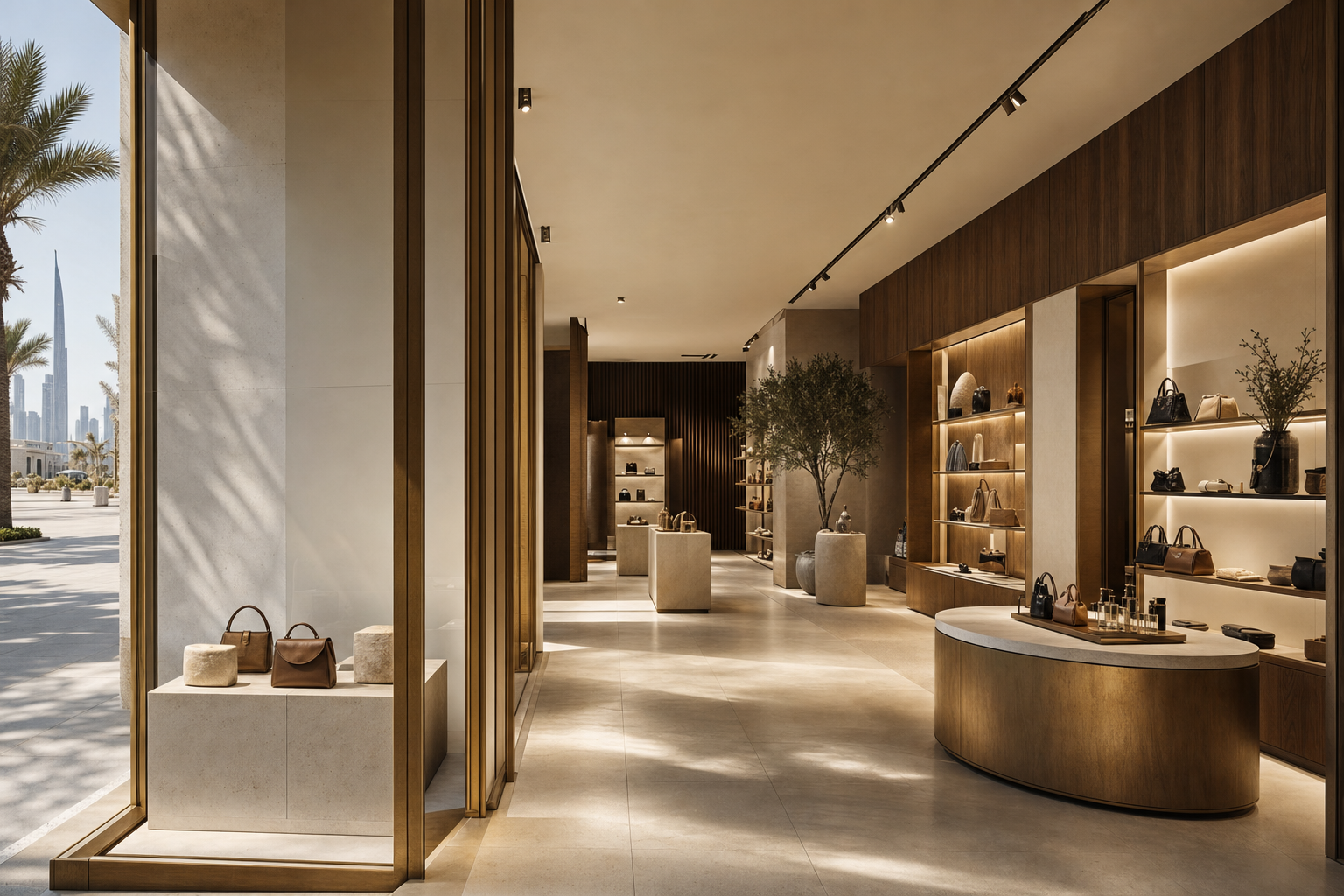
In a market as visually loud as Dubai, the shopfront does most of the work before a customer ever steps inside. It has to read instantly, communicate the brand and the price point in a glance, and frame product or a single hero display that draws the eye. Glazing, signage, the entrance zone and the transition from mall or street lighting to your interior lighting are the elements that decide footfall. In a mall, the shopfront also has to satisfy the landlord's design criteria, hoarding rules and height and material limits. The mistake we see most is spending the budget on the back of the shop where few customers reach, and under-investing in the first three metres that actually determine whether anyone comes in at all.
The customer path is a design decision, not an accident
Good retail choreographs movement. The layout decides where the eye lands on entry, which way people turn, how far they travel, and where they pause. Decompression zones at the entrance, a clear sightline to the back, considered adjacencies between categories, and a till positioned so it is easy to find but never the first thing you see, these are deliberate choices backed by how people actually shop. Fitting rooms, if you sell apparel, are their own conversion battleground and deserve proper lighting and space. The goal is a path that feels effortless to the customer and quietly maximises exposure to product for you. This planning happens long before a finish or fixture is chosen.
Lighting is the highest-return line item in retail
Nowhere does lighting matter more than in retail. Ambient light sets the mood, accent light sells the product, and the contrast between them creates drama and draws the eye to what you want seen. Colour temperature and colour rendering are commercial decisions: the wrong light makes stone look grey, fabric look cheap and skin look tired in the fitting-room mirror. Track and spot systems need enough circuits and flexibility to relight as displays change through the season. In Dubai, where mall base-build lighting is often flat and cool, a considered retail lighting scheme is one of the clearest ways to make a space, and its product, feel premium. It is also one of the most common places a value-engineered fit-out quietly fails.
Display joinery and materials do the branding
After the shopfront and lighting, bespoke joinery is where a retail budget goes and where the brand becomes physical. Vitrines, plinths, wall systems, cash desks and back-of-wall storage all have to be beautiful, durable and flexible enough to restage as ranges change. Material choice carries the price positioning, warm timber, honed stone, brushed brass and good glass read as considered and premium, while the wrong laminate reads as temporary. Durability matters more than in a home: retail finishes take relentless traffic, cleaning and knocks, and Dubai's cleaning regimes are aggressive. We specify materials that hold their finish under that load, because a shop that looks tired within a year undoes the investment that opened it.
Mall, street and free zone change the rulebook
Where your unit sits changes everything about the process. A mall unit answers to the mall's design and delivery team, with a fit-out manual, design criteria, approved-contractor lists, night-only works, strict hoarding and hourly handover windows, our retail and showroom work in Dubai Mall runs to exactly this kind of framework. A street-facing or community-retail unit on the mainland follows Dubai Municipality and Dubai Civil Defence processes and the building owner's rules. A free-zone showroom adds that authority's own fit-out manual. None of this is a reason to avoid a premium address, but a mall flagship and a community showroom are genuinely different projects in cost, programme and approval load, and they have to be priced that way from day one.
What a retail fit-out costs and how long it takes
As 2026 starting points for considered, well-built work: a modest boutique or showroom commonly starts from around AED 300,000 and scales to AED 1,500,000 or more for a flagship with bespoke display systems, feature lighting and premium finishes. As a build rate, expect roughly AED 350 per square foot for a simple fit-out up to AED 700 or more for joinery- and lighting-heavy environments. On timing, a straightforward unit runs 10 to 14 weeks from contract to handover; a mall flagship runs 14 to 16 weeks or more once the landlord's stages and night-work constraints are counted. Shopfront glazing, feature joinery and imported fittings carry lead times of six to twelve weeks, so procurement, not construction, is usually the long pole. For a fuller breakdown, see our interior design cost guide for Dubai.
Where ZuriSpace fits
ZuriSpace designs retail and showrooms as part of our wider commercial interior design work, bringing a calm, material-led sensibility to spaces that usually shout. Subhra leads each project personally: we design the shopfront, path, lighting and display systems in-house, coordinate the mall or authority approvals as part of the scope, and oversee the build on site through trusted contractors, with every quotation itemised after a first consultation. The aim is a shop that performs commercially, converts footfall and holds its finish, while still feeling considered enough that customers want to linger, which in a mall full of near-identical fit-outs is its own advantage.
Quick answers.
As a 2026 starting point, a modest boutique or showroom commonly starts from around AED 300,000 and scales to AED 1,500,000 or more for a flagship with bespoke display systems and premium finishes. As a build rate, expect roughly AED 350 per square foot for a simple fit-out up to AED 700 or more for joinery- and lighting-heavy spaces. Mall units run higher once the landlord's requirements are counted.
A straightforward unit runs 10 to 14 weeks from contract to handover. A mall flagship runs 14 to 16 weeks or more once the mall's design approval stages, night-only works and handover windows are counted. Shopfront glazing and bespoke joinery carry six-to-twelve-week lead times, so procurement usually sets the schedule rather than the construction.
Most Dubai malls publish a fit-out manual and design criteria, require contractors from an approved list, and control the shopfront design, hoarding, works hours (often night-only) and handover windows. You submit design and MEP drawings for approval, build to defined stages with inspections, and hand back to a tight schedule. This adds time and cost compared with a standalone unit and should be programmed in from day one.
The shopfront, the customer path and the lighting, in that order, matter more than the finishes. The shopfront decides footfall, the path decides how much product each customer sees, and lighting decides how good that product looks and how premium the space feels. Bespoke display joinery then makes the brand physical. Spend here first; a beautiful back wall few customers reach is the wrong priority.
A fit-out contractor can build, but retail lives or dies on decisions a builder is not equipped to make: shopfront pull, customer path, lighting design and display strategy. A designer-led project protects those decisions through to opening. At ZuriSpace we design retail in-house and oversee the build on site through trusted contractors, so the commercial intent survives value engineering and the brand opens as designed.
- Retail and showroom design in DubaiShopfronts, display joinery and lighting for boutiques and showrooms.
- Retail and showroom design in Dubai MallWorking to a mall's fit-out manual, approved contractors and night-work rules.
- Commercial interior design in DubaiHow office, retail and F&B projects differ in cost and approvals.
- Interior design cost in Dubai (2026)How spend breaks down across residential and commercial work.

Written by
Subhra
Founder & Principal Designer
Subhra is the founder and principal designer of ZuriSpace, leading every project from first conversation to final reveal across the UAE and India.
Read Subhra's profile →